
Blog post
Whether you are laying a drinking water line for a small town, irrigating farmland in the Terai, or planning a rural water scheme in the hills, the pipe you choose decides how long the system lasts and how much you spend on repairs. In Nepal, HDPE pipe (high-density polyethylene pipe) has become the first choice for water supply, irrigation and drainage, and for good reasons.
This guide explains, in plain language, how to choose the right HDPE pipe for your project, what the technical terms on a pipe mean, and what to ask any supplier before you order. It is written by the team at Kamla Polythene and Plastic Industries Pvt Ltd, the HDPE pipe manufacturing unit of BN Mahto Group, which has served Nepal since 1987.
Why HDPE PIPE suits Nepal
Nepal's conditions are hard on pipes: steep hills, landslide-prone slopes, earthquakes, temperature swings and long distances between source and village. HDPE handles these better than many traditional materials.
- Flexible and tough. HDPE bends around curves and absorbs ground movement, so it copes better with settling soil and tremors than rigid pipe.
- Corrosion-free. It does not rust or scale, so water quality and flow stay consistent over the years.
- Leak-resistant joints. Heat-fused joints become as strong as the pipe itself, which sharply reduces leakage at joints.
- Lightweight. Coils and lengths are easy to carry to remote sites, which lowers transport and labour costs in hilly areas.
- Long service life. Properly selected and installed PE100 pipe is designed for a service life of 50 years or more under normal conditions.
- Smooth inner surface. Less friction means better flow and lower pumping energy.
PE80 vs PE100: which material do you need?
HDPE pipes are made from different material grades. The two you will see most often are PE100 and PE80.
PE100 is the stronger grade. Because the material is stronger, a PE100 pipe can have a thinner wall than a PE80 pipe at the same pressure rating. That means a larger inside diameter, more water carried, and often lower cost per metre of delivered capacity. PE100 is usually the better choice for main supply lines and higher-pressure schemes.
PE80 is still widely used for lower-pressure, smaller-diameter applications such as farm distribution and household connections.
Kamla Polythene HDPE pipes are manufactured in [PE100] using [virgin raw material from world's Reputed supplier as per NS 40: 2079
Understanding PN and SDR ratings
Two markings on every pipe tell you what it can handle.
- PN (Pressure Nominal) is the maximum continuous working pressure in bar at 20 °C. A PN10 pipe is rated for 10 bar, roughly 100 metres of water head.
- SDR (Standard Dimension Ratio) is the ratio of pipe diameter to wall thickness. A lower SDR means a thicker wall and higher pressure capacity.
For PE100 pipe, the common combinations are:
|
SDR |
Pressure rating (PN) |
Typical use |
|---|---|---|
|
SDR 41 |
PN 4 |
Low-pressure gravity and drainage lines |
|
SDR 26 |
PN 6.3 |
Low-pressure irrigation, distribution |
|
SDR 21 |
PN 8 |
Irrigation, small water schemes |
|
SDR 17 |
PN 10 |
General water supply, rising mains |
|
SDR 13.6 |
PN 12.5 |
Higher-pressure supply lines |
|
SDR 11 |
PN 16 |
High-pressure mains, steep terrain |
|
SDR 9 |
PN 20 |
Very high-pressure applications |
For PE80, the same SDR gives a lower pressure rating (for example, SDR 11 is PN 12.5 in PE80).
A practical tip for hill projects: in steep terrain, static pressure at the bottom of a slope can be far higher than the pressure at the source. Calculate the pressure at the lowest point of your line, and choose a PN rating with a safety margin above it.
Which size and rating for which job?
|
Application |
Typical choice |
|---|---|
|
Drinking water supply to towns and villages |
PE100, PN10 to PN16 |
|
Gravity-fed rural water schemes |
PE100, PN6 to PN10, depending on elevation drop |
|
Farm irrigation and tube-well lines |
PN6 to PN10 |
|
Household and small branch connections |
Small-diameter PE80 or PE100 coils |
|
Drainage and sewage lines |
Lower PN or non-pressure pipe, as designed |
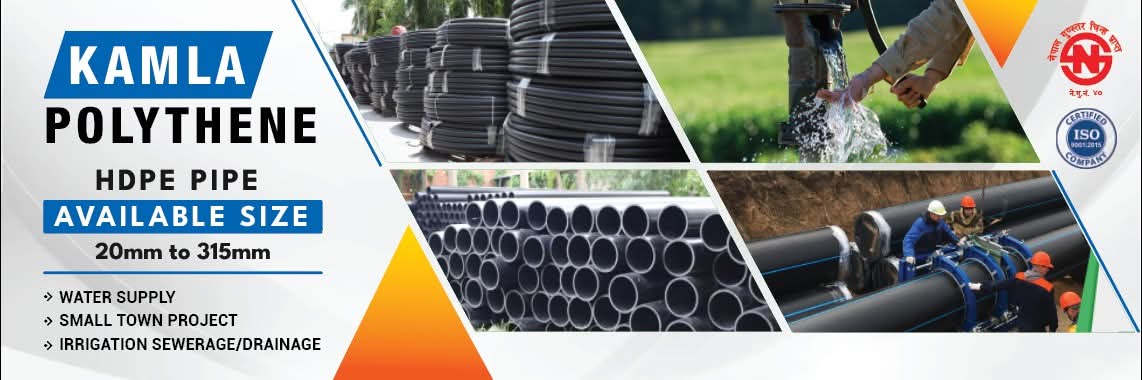
These are starting points only. Always confirm against your engineer's design. Kamla Polythene supplies sizes from 16 mm to 315 mm in 300mtr, 200mtr,100mtr coils / 6mtr straight lengths.
Joining HDPE pipe the right way
A pipe is only as good as its joints. The main methods are:
- Butt fusion. The pipe ends are heated and pressed together to form one continuous, leak-free pipe. This is the standard method for larger diameters.
- Electrofusion. A fitting with built-in heating wire fuses the joint. This is useful for repairs and tight spaces.
- Compression fittings. Mechanical joints, common for small-diameter lines and household connections.
Use trained installers and proper fusion machines. A badly fused joint is the most common cause of failure in an otherwise good HDPE system.
Seven questions to ask any HDPE pipe supplier in Nepal
Prices vary, but price alone is a poor guide. Before you order from any manufacturer, ask:
- Which standard does the pipe meet? Ask for the Nepal Standard (NS) and any ISO or other certificates, and check the certificate numbers.
- Is it PE80 or PE100, and is the raw material virgin? Recycled or filled material weakens the pipe and shortens its life.
- What are the PN and SDR, and are they marked on the pipe? Reputable pipe is permanently marked along its length.
- Can you provide a test report or datasheet? Look for dimensions, wall thickness and pressure test results.
- What diameters and lengths are in stock? This affects your project schedule.
- Can you deliver to my site, and how long will it take?
- Who supports me after the sale? Good suppliers advise on jointing, installation and sizing.
You should be able to put these questions to any company, including us. We welcome them.
What makes Kamla Polythene different
Kamla Polythene and Plastic Industries Pvt Ltd is part of BN Mahto Group, a Nepal-based manufacturer with decades of experience in power, water and infrastructure supply. Here is what you can expect from us:
- Made in Nepal, close to your project. Manufactured in Janakpur, which supports quicker supply and easier follow-up for projects across the Terai and beyond.
- Quality you can verify.NS 40 : 2079 and ISO 9001: 2015 certified company ; in-house testing carried out like dimension checks, Hydrolic Pressure tests, Reverson Test etc.
- Proven on real projects. Raman Construction reports that Kamla Polythene HDPE pipe has been used on several small-town projects in Nepal, with quality maintained to Nepal standards and delivery made on time. similarly WSSDO (Water supply and sanitation Division Office, NWSC (Nepal Water Supply corporation), Lili Helvitas, NEWAH (Nepal Water For Health) are few recent clients.
- Technical support. Our team helps you match diameter, PN rating and quantity to your design before you order.
- A full group behind you. BN Mahto Group also supplies Elex transformers, ACSR conductors, PSC poles and Hume pipes, so contractors can source several items for a project from one trusted group.
How to order Kamla Polythene HDPE pipe
Getting a quote is simple. Send us:
- Your project location and application (water supply, irrigation, drainage)
- The diameter, PN rating and quantity you need and we will help you choose
- Your delivery location and required date
Contact the HDPE pipe sales team: +977 9801622252 / 9801622254 Email: [email protected] Visit: BN Mahto Group HDPE Pipe page | Kamla Polythene | Download our catalogue | Contact us
Frequently asked questions
Is HDPE pipe safe for drinking water? Yes. HDPE pipe made from suitable potable-grade material is widely used for drinking water around the world. Confirm that your supplier's pipe is intended for potable water use.
How long does HDPE pipe last? PE100 pipe is designed for a service life of 50 years or more when the correct pressure rating is chosen and the pipe is installed properly.
What is the difference between HDPE and PVC pipe? HDPE is more flexible, handles ground movement and impact better, and can be joined by fusion into a continuous, leak-free line. PVC pipe is rigid and uses solvent or gasket joints. HDPE is often preferred for hilly, earthquake-prone and long-distance routes.
Can HDPE pipe be used underground and above ground? Yes. It is commonly buried. For exposed above-ground use, choose pipe suitable for sunlight exposure (typically black pipe with UV stabiliser) and support it correctly.
What is the price of HDPE pipe in Nepal? Price depends on diameter, PN rating, material grade, quantity and delivery location, and it moves with raw material costs. Send us your requirement for a current quotation.
Does Kamla Polythene supply outside Janakpur? Yes, we serve projects across Nepal; Contact our sales team with your site location.
Conclusion
The right HDPE pipe saves money for decades. Choose the correct material grade, match the PN rating to your real pressure, insist on proper jointing, and buy from a manufacturer that can prove its quality and support you after the sale.
Ready to start? Request a quotation from Kamla Polythene today and our team will help you select the right pipe for your project.